This project has been made possible by a grant from the Creative Arts Council of Brown University.

Monday, April 16, 2012

Long, convoluted, and overdue reflections on an installation


I am writing these reflections quite a while after the installation came down. Originally, I told myself I was waiting to acquire the photographs taken at the installation, in order to use them alongside my ruminations. But it soon became clear to me that the delay that had nothing to do with the photographs. Rather, the delay arose because I felt that the project had reached an ending point. Although I wanted to, and felt I should, reflect on and document some of the experience, I was not motivated to sit down and write, but as soon as I realised the reason for my procrastination, I was able to overcome it. As a consequence, a lot of thoughts have accumulated, and this post has taken on a more essay-like length that I did not originally intend…
I wrote that the project has reached an ending point. The article is important—it has not reached the ending point, but an ending point, merely one of many points at which it feels it could end. This was definitely not the case after the performances in November, as at that point in the process I continued to want to think and write about the project. I felt there was a need for continued exploration of what had come up.
The installation provided the space for this exploration. It was fulfilling, and revealing, to come back to the content and themes of the project after the performances, and to look at them anew. Exploring different applications of the same ideas and different iterations of the same material allowed for new connections and realisations. Collaborating with Adj and Slim contributed hugely to this because they brought different perspectives. The collaboration also drastically altered the experience for me; although I was involved in the conceptual development, I was not directly involved in producing some of the installation components. Until I saw it installed, I did not know exactly what Adj’s floor piece (Dancing Through Time) looked like, or even what photos had made the final cut. Likewise, I could not predict exactly what Slim’s projections would look like, as I was not involved in the final stages of their design and creation. I had both a creator’s/insider’s knowledge and a visitor’s delight and surprise when I saw the installation.
I was delighted that people did not refrain from stepping on Adj’s floor piece, Dancing Through Time, and that many took time to read some of the quotes and investigate the double-layered images. It was interesting to have the excerpts and memories in text form directly under the ones in audio form featured in a soundtrack comprised of excerpts of recorded conversations about the Arcade. Unfortunately, the soundtrack was hard to hear in the space due to the level of noise—both conversation and the soundtracks from the other works on display in the building. The different volumes and speeds of different voices likely contributed to this, and may have made this component of the installation more suited to a private display space, or more effective on headphones. But perhaps the odd detail that came through for a visitor here or there made for a more organic experience of those memories than if a visitor sat down with an intention to listen to them on headphones. Perhaps those fragments of memory filtered into someone’s subconscious.
Due to practical constraints, some elements of the installation had to be tweaked a little. The projectors in each of the living rooms did not have the mobility we had hoped for, and so Slim and I could not quite realise the projections that we had envisioned. One of the things that Slim responded to in the performances was the way that the audience had to make choices, and had their passivity challenged. To that end, he wanted the installation visitors to also have to make choices and to use projections that shifted between the two “living rooms” on different levels to make the aware of those choices. He entitled his component of the installation Move!  The technical limitations altered our plan, but Slim was able to work within the constraints to try and facilitate the same fundamental idea. I am still not sure how successful it was in terms of the original goal, and I have not been able to get feedback that helps us evaluate that. But I saw people commenting on the projections, or just spending a while watching them, so their presence was definitely noticed, and people will have drawn from them what they will.
The green taped line emulating the Independence Trail in downtown Providence was the other element to undergo some alterations due to technical constraints. Originally envisioned running along the floor and up the staircase, the tape would have damaged the unsealed concrete on the steps. The compromise was to have it run along the floor in the living room spaces and then up the side of the stairway rather than on the steps themselves. This made the line less prominent. But it also dictated less, asking less obviously to be followed, and more subtly suggesting a connection between the two levels.
The two elements where a compromise needed to be found were the two whose purpose it was to link the living room spaces together. The decreased visibility of the green line detracted from this function, as it less prominently lead from one living room to the other. Similarly, the movement of the projected images was much more subtle, and did not link the spaces as clearly as envisioned. Nevertheless, connections existed. The cantilevered design of the staircase (where the landings are the “living rooms”) allows for an uninterrupted stretch of white wall that runs the height of the building. The balconies and landings are angled such that often both projections and both living rooms were visible, creating connections between the two halves of the installation in ways that I had not fully anticipated.  So perhaps our objective of linking the two living rooms in an emulation of the way that the performance linked the various spaces of the Arcade was not met as clearly as envisioned. But hopefully others made connections that I had not planned, and did not see.

Tuesday, March 6, 2012

Installation notes

To go a little deeper into my ideas concerning this phase of the project, here is the text I have written to accompany the installation:


This installation is a re-imagining of “An Arcade Project”, a place-based dance project developed between August and November 2011. The four-month process culminated in performances at the Westminster Arcade in downtown Providence on the 18th and 19th November 2011. However, although the project was oriented towards the development and presentation of the performances, they were only one aspect of a multi-faceted process that also produced a large number of photographs, voice recordings, video footage, and blog posts. This installation explores the nature of the work that was done, re-imagining and re-presenting what “An Arcade Project” was, and is, in its holistic, yet fragmented entirety. 
Mediation was a central theme in “An Arcade Project”. Multiple layers of mediation were involved in the various outcomes of the project, connecting disparate sources and transposing ideas between mediums; bodies mediating memories, memories mediating place, bodies mediating place, archives mediating place, video mediating bodies, photographs mediating bodies mediating place…the list circles back on itself endlessly. In a continuation of this theme, this installation re-mediates various outputs of the project, reassembling them to create new juxtapositions and new relationships between individual components.
Like the performances, the installation is about experience of place. At the performances, both the performers and the audience created the experience by making movement choices that defined their interactions with and perceptions of spaces. The installation also invites audience agency, using the design of the Granoff Center to encourage exploration—explorations of space, of ideas, of histories, and, of course, of the Arcade itself.

Friday, March 2, 2012

An Arcade Project, Installed

Plans for the installation are underway, and we have a much clearer idea of the different elements that will make up the installation since the last time I posted about it. I say we, because this undertaking is a collaborative one. Friends and colleagues of mine Adj Marshall and Seung Chan Lim (Slim) are artistic collaborators, and Emily MacCartan has generously taken on the responsibility of coordinating the installation and making it happen.

The fundamental idea driving the layout of the installation is to reference and re-create some of the same exploration of the space and agency that the audience had in the performances. To that end, the installation will be located in two of the "living room" spaces of the Granoff Center that are directly above one another. Adj and Slim were both photographers at the performances. Slim's photos are going to act as one prompt to move around and investigate, in much the same way that the dancers did in the performances. The other element designed to invite is a green line that runs through and between the spaces, referencing the Independence Trail in downtown Providence that runs by the Arcade. Adj has been working with the photos she took as well as with some of the archival photos of the Arcade to create multi-exposure photographs that offer a cross-temporal vision of the Arcade. The two other elements that make up the installation are the edited film of the performance and a soundtrack composed of excerpts from different interviews that I conducted in the course of my research.

The installation will be on display in the Granoff Center for Creative Arts from 12th-17th March, 2012. 


Sunday, February 12, 2012

The Providence Postcard Project

Last week at the Granoff Center for the Creative Arts at Brown University was the opening of “The Providence Postcard Project” by artist Betsey Biggs, which featured a postcard of the Arcade. It was a project realised as part of the Urban Cultural Heritage and Creative Practice international research collaborative, and is summarised in this excerpt from the UCHCP website:

1000 postcards – 100 photographs – 22 neighborhoods. ”The Postcard Project,” by artist Betsey Biggs, explores the familiar souvenir medium of postcards as a source of reflection by the residents of Providence on what meanings the city holds. Beginning this week, the project will be distributing pre-addressed, postage-paid postcards featuring photographs taken by Biggs during her visits to the neighborhoods of Providence. Local residents and members of the general public are invited to pick up postcards at Providence Community Library locations throughout the city, write to the Postcard Project, and share their own stories about the many places of Providence.
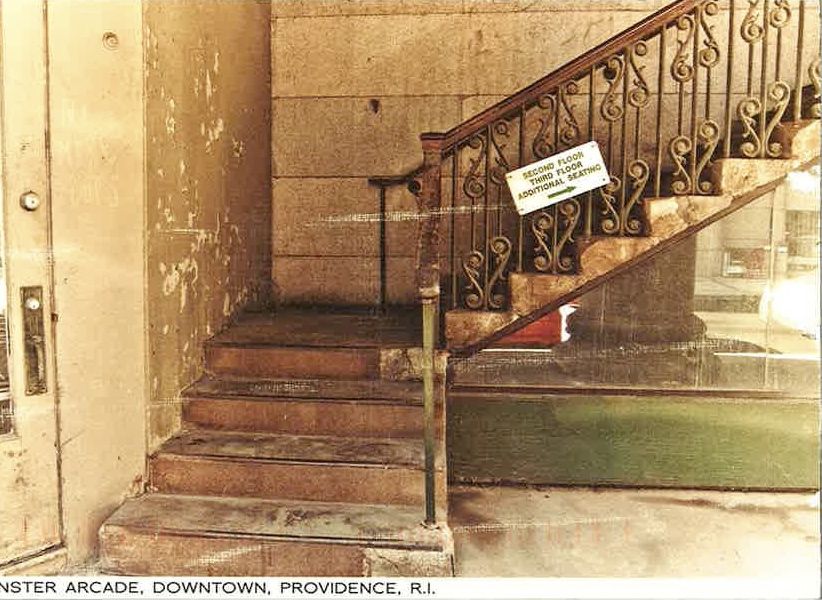
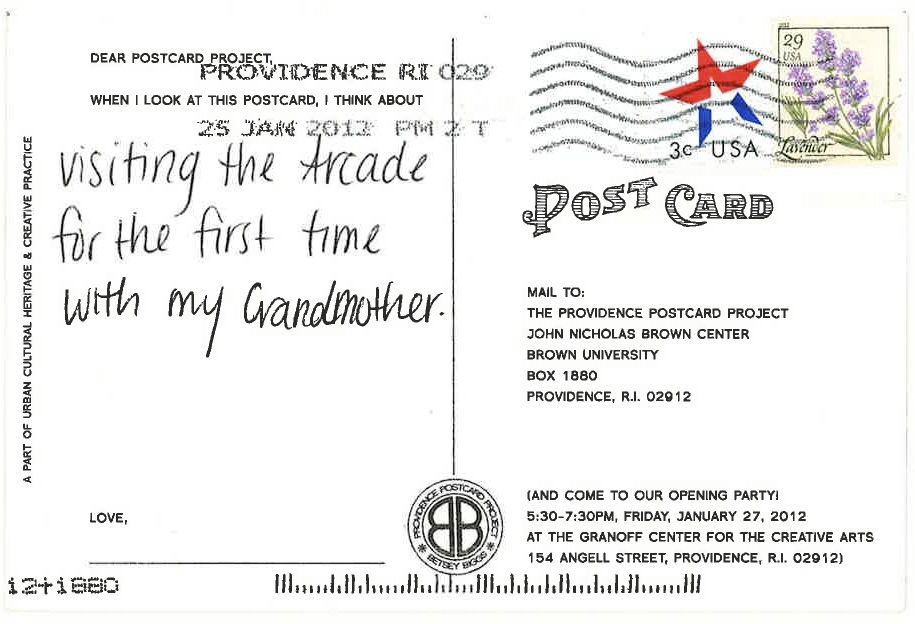
One of Betsey’s photographs featured the Arcade, and there were some fascinating responses that I got to read at the opening of the exhibition. Betsey was kind enough to let me reproduce the Arcade postcards on this blog, as they provide an interesting addition to the research conducted for this project.


Front of the postcard featuring the Arcade, from "The Providence Postcard Project" by Betsey Biggs. The photo depicts the stairs to the second balcony level on the Weybosset St side.


When I saw this postcard at the opening reception of the exhibition, only the top message was there. This was written by Tim, one of the dancers involved in this project, and details the phrase that occurred on these steps as part of the piece. The message below was added during the time the exhibition was up, and seems to be a response to the new plans unveiled for the Arcade.


I would love to hear more of this story.


This was another postcard that had a second note added to it while being on display in the Granoff. The sideway message is hard to make out, but reads roughly as follows:

'Worked on second floor in sales / saw many stores come + go / 2nd floor not much traffic. First night nice music they hosted/ Johnson + Wales / store (?) full of yummy thin (?) / the Prov ____ / ____? not sure but giant cookies'


Cookies have come up before in some of the interviews I did way back in September (see here and here for two sets of memories that involved the cookies); memories connect and interweave, maybe blur, and ultimately reinforce a sense of place triggered by the invitation to write on the back of an empty postcard. 


Thursday, February 2, 2012

Next steps

Since the time of the performances, almost exactly three months ago, I have continued to think and reflect on the project. Despite envisioning the performances as something of a culmination, I was aware that there would be a period of processing and reflection. Some of this (as much as I could manage) has made its way onto this blog, but much has not, some of which I hope has been going on in the minds of others. One thing that has come up for me is how central the theme of mediation is to the project. Especially after seeing the the video footage and still photographs that were taken during the performances, I realised just how many layers of mediation are involved in the various outcomes of the project: bodies mediating memories, memories mediating place, bodies mediating place, archives mediating place, video mediating bodies, photographs mediating bodies mediating place…the list circles back on itself endlessly.

The appropriate response to this continuous mediation of place with its many rich layers seems to be to highlight it, and to that end I am starting to work on an installation version of “An Arcade Project.” 

“An Arcade Project, Installed” will be exhibited as part of the American Dance Legacy Initiative’s winter Minifest, and will be displayed during the second week of March in the “living room spaces” of the Granoff Center for Creative Arts at Brown University. My ideas for the installation are still taking, and shifting, shape. But here are a few preliminary ideas for things I am interested in including: video footage of the performance, an audio soundtrack of the interviews, feedback and thoughts on the piece, still photographs (framed and hung? projected onto walls?), and I would really like at least one interactive component. Since I did not take any of the video footage or photographs, this installation will almost certainly involve some collaborators, and I am excited to see in what new ways the project material manifests itself through this collaboration.

Meanwhile, the life story of the Arcade continues, and I continue to document news and stories related to the building.

Friday, January 27, 2012

The future of the Arcade

There were some whispers of plans for the Arcade a few months ago (discussed in this previous blog post), but now it seems for certain that the Arcade has renovation in its future.

On January 25th Mayor Angel Taveras, Senator Jack Reed, Governor Lincoln Chafee and representatives of the Arcade attended an unveiling ceremony for the new plans. They were joined by "more than 100 business leaders, government officials and downtown leaders" according to this article on the official website of the city of Providence.

The new incarnation of the Arcade will be a combination of retail and residential spaces. Shops and restaurants will fill the ground floor spaces, and, in a departure from previous designs, the second and third levels will be converted into 48 loft-style apartments. According to the Daily Dose, the apartments "will be furnished, including refrigerators, dishwashers and microwaves - but no stoves - will be marketed toward recent college graduates and young professionals, Granoff said. Rents will start at $550 per month". The no stoves part is an interesting one- perhaps limited by fire restrictions on a historical building? It will be interesting to see how this feature affects the clients that these apartments will attract, and whether this stipulation will eventually be modified. (A comment left under this article raises a good point: "Why would they need to waste what little space they have with a dishwasher? they don’t have stoves, so I think just using the old sink and drying rack method would work").

The title of the Providence website article, "A Providence Landmark is Reborn" suggests that a similar rhetoric to the rhetorics of the past is being used about the Arcade today. Themes of monumentality, historical significance, and myth abound.

The reopening of the Arcade is an exciting development for Providence...This project breathes new life into America's oldest indoor mall and one of our city's most historically significant buildings, with a mix of retail, restaurants and affordable housing for young professionals in the heart of downtown Providence. --Mayor Angel Taveras 
It will be called The Arcade Providence and it will be a historic revival...This historic revival will create an Arcade community, increase the energy in the heart of downtown, help drive business to surrounding retailers, attract new retail and restaurants, and bring micro-loft residents into downtown to live, eat and shop - and it begins today. --Mr Granoff

It is hard to read these descriptions of the Arcade and not be reminded of similar rhetoric used just over 30 years ago in  conjunction with the 1980 renovation and opening of the Arcade. Specifically one quote discussed a previous blog post comes to mind. Taken from the 1980 opening campaign, it describes how the Arcade is "not just in the heart of Providence. It is the heart of downtown Providence."

Photo of Mayor Angel Taveras at the Arcade on 25th January, 2012. Photo from http://providenceri.com/mayor/a-providence-landmark-is-reborn

Tuesday, January 10, 2012

Conversation notes

These are my notes from a conversation with Laura (who I interviewed earlier in the year about her memories of the Arcade) after she saw the performance where she shared some of her thoughts:

The building should be listed as a cast member- the dancer's relationship to it gave it character, personality.
It successfully created a structure to work with the 'accidents', moments where people not involved in the project became a part of it.
It made you look at everything differently.
'Mirror duet' was the "most effective" part- it brought the two sides of the Arcade together.
The piece as a whole created a situation where there was a lot for the audience to "puzzle out".

Her comment that "it made you look at everything differently" is particularly exciting for me to hear, as part of the intention was to re-contextualise and de-familiarise the space to allow multiple identities for the space, and create new relationships to it.

And although there are several parts of the piece that I find particularly satisfying, the 'mirror duet' is definitely one of them. This is the section where Amy and Nadia perform the same phrase across the length of the Arcade. One performs it on the right, one on the left, so they mirror each other. It is discussed more in this post and can be seen below.


It is one of the most successful moments in terms of connecting the two sides, but also in challenging the audience's perception of being able to see the whole picture, imparting a fuller understanding of the sense of the spatial extent of the Arcade, and in playing with the inaccessibility of the interior.

Friday, December 30, 2011

Reflections: Family Portrait

Since the performances I have been having conversations about the piece that continue to deepen my reflections on it.

In a conversation with dancers Natasha and Kelli about three weeks after the performances, the "family portrait" section came up as one of the most interesting/provocative moments of the piece for them. This is the part when Natasha, Kelli, Tim and Nadia sit on the Westminster steps for an extended period of time (Amy is making her way around from the Weybosset side) staring straight ahead, almost sitting to attention, in a way reminiscent of a posed portrait.

N: It was "the most banal movement-wise, but it lasts for long enough that it stands out as odd in the context of people walking by."
K: "It was more startling, which I find to be odd, than the parts when we were moving more."
A recording of 'Family Portrait' from Saturday's performance, filmed by Sam Holland, can be seen in the clip below. This photo from an earlier post is also of 'Family Portrait'.


It is one of the moments that I find the most satisfying and delightful because of its 'oddness'. It lasts a little longer than is comfortable (just over a full minute); there is an expectation that something that should happen, but it doesn't. Yet I find that it remains interesting because of the ambiguous relationship set up between the four performers.

Friday, December 23, 2011

An Arcade Project in the Inventory

This is a piece that I was asked to write for the Inventory, the newsletter of the Joukowsky Institute for Archaeology and the Ancient World at Brown University. The full newsletter can be found here.

Monday, December 19, 2011

Reflections from an audience member

These are some reflections from Mimi, an audience member who was generous enough to share her thoughts on the piece with me:
Going past the Arcade is a different experience for me now since seeing your piece; I have a connection to it. It has made me think about the theme of common property.  Experiencing your piece made me feel some sort of ownership of the environment I live in which I didn't have before. Perhaps a lot of people feel disconnected to buildings and urban spaces because they do not 'own' them, but your piece brings to mind how abstract the concept of property is. That is why I couldn't help think about your piece in the context of Occupy Providence. Here is a movement that is making people feel empowered enough to have more 'ownership' then they do. Occupying a public space allows people to become more engaged with those around them.
Back to your piece: although the Arcade is not 'public,' I felt that your piece made it so. I also liked how I, as an audience member, could interact within the piece. By interacting, I mean that when I had to follow the dancers around to each side, I felt that I had become part of the dance essentially. It felt initially strange, like I wasn't supposed to, but then I understood the importance of doing so.
I saw some skateboarders doing some tricks on the steps of the Arcade the other day. They had made a unique connection to the space in the same way your piece did. It's a connection that perhaps more the people who go in and out of Downtown PVD would never experience. What a gift I think!
The connection with the Occupy movement is an interesting one that had not crossed my mind at all- a pertinent example of the way in which audiences can find significances and associations that were not intended by the creator. It also speaks to the way in which context is crucial. Seeing this piece while the Occupy movement is constantly in the media allows for different connections than if the piece had occurred this time last year before the movement, or even if it had occurred in a location more geographically removed from the site of Occupy Providence (Burnside park is just on the other side of Wesminster Street, across Kennedy Plaza); like any work it does not exist in a vacuum but constantly informs, and is informed by, both its temporal and spatial context.

Thursday, December 15, 2011

Photoblogged

"An Arcade Project" is featured on the photoblog of shellfishmeme with this photo taken during the performance on Saturday 19th Novemeber:


Photo by Mimi Roterman

Dancer response #1

Because we had not rehearsed the piece as a whole (that is through its 3 repetitions) until the day of the performance it gave an interesting liveness to intention in my own movement. I had never created a model to work towards but just fell in with what was there. The tension in my torso, the pace of my breath, the force in my legs changed every time (through the 6 repetitions of each day). Allowing for such un-predetermined shifts equally allowed my mind to wander: I could just be sitting on the steps looking over those people (the audience) staring at me instead of trying to look past them; think of the work i had to do the next day and miss my cue. I had a wonderful experience of straddling the edge of a rehearsed work and the very nowness of a performed one; which I believe is most suitable for sitting on a portico between an unused and inaccessible past (the arcade) and a trafficked and passing present (the street).
                                                             -Tim


Photo by Seung Chan Lim

Tuesday, December 6, 2011

Coverage in the Indy

As part of a larger piece on modern dance in Providence, Lizzie Feidelson covered "An Arcade Project" in the latest issue of The College Hill Independent. The article can be read in an online, digital format below:


Tuesday, November 29, 2011

BDH coverage

Brown Daily Herald writer Maggie Finnegan covered the performances, and the story as it appears on the BDH website is embedded below. It can also be seen on the BDH website here.

Sunday, November 27, 2011

Reflections, continuing

In talking about the piece, I have had to try and articulate what it is in the choreography I created and directed that is interesting to me. Frequently I have described these moments to the dancers as being "a litte bit weird" or having a "weirdness" about them. In trying to unpack exactly what I mean when I say this, and to get at the essence of what it is that appeals to me, I would say the following: I am interested in exploring moments where the physical relationships between performers (those relationships created spatially between two or bodies) do not line up with the psychological (which could also be described as emotional, or social) relationships suggested by the movement; the disconnect between the two accounts for the "weirdness" and my interest in these moments.

To put this in a less abstract form, take as an example the vignette in "An Arcade Project" shown below (this footage was shot during rehearsal, hence Kelli and Natasha sitting down early and then leaving again):


Nadia and Timmy climb over each other repeatedly, and in between the climbing sequences they sit next to each other and stare straight ahead, deadpan. Their close proximity- their bodies physically impose on and interrupt one another- are at odds with the psychological distance of their detached stares. The physical interactions are entirely out of place in a social, physical space when two people might end up sitting near one another (such as waiting for a train, or sitting on the Arcade steps during a lunch break) but where their psychological, emotional, or social relationship is that of distance, of two strangers.

It is important to note that I do not want to make the infinite ways in which bodies can relate to one another into an essentualised binary; rather, these two categories (physical/spatial and psychological/emotional) are two ways of many in which relationships between bodies could be categorised and understood. Perhaps you could also say that they are two categories I am interesting in creating, setting them up in order to then create the disconnect between them that I find interesting.


Something else I have been reflecting on is that, ultimately, I am interested in creating experiences. These are inherently going to be different for everyone- for creator, performer, audience, and also different between audience members, between performers; it is not the creation of one universal experience, but the presenting of a situation in which one might have an experience. Taking a step back, ultimately, the creation of any piece of performance is the creation of an experience- or even the creation of anything. But I would like to make this experiential aspect more conscious, thinking of creating dance as primarily creating, or facilitating, experiences.

Wednesday, November 23, 2011

Some documentation

Here are some more of the photos (and a video!) that I took during Saturday's performance:

Compelling in the fullest sense of the word- what does he see?


A spectator/photographer watches Kelli and Amy's duet


Tim makes a good base


A moment of stillness. What is up there?


Tuesday, November 22, 2011

Audience reflections (reflections on an audience)

I expected Saturday’s performance to feel different than Friday’s since a weekday downtown is very different from a weekend morning- there are significantly less people, since many work weekday 9-5 office jobs in the area around the Arcade. The tobacco shop is also closed on the weekend, and during Friday’s performance there had been a number of people walking across the Westminster portico going in and out of the shop, often navigating the dancers to do so. It was great to hear some anecdotes from the dancers about the way that people responded; one woman’s comment as she walked by them was “weird”. But there were (almost) no bodies moving through that space on Saturday morning except the dancers. 


On Saturday there was a larger audience composed of people who had specifically come to see the performance. However, defining the audience solely in this way is misleading. I talked to someone from the Brown Daily Herald who is covering the performances, and one of the questions she asked me was “how big was the audience?” 


My response was that estimating the audience size was not really relevant for a lot of site-specific works, including this one. It is a question that brings up some interesting ideas regarding how we conceptualise and define an audience. I would say that the common conception is inherently defined by proscenium performance, where there is a designated space for spectators. This spatialising of the audience defines and dictates their role in relation to the performers. But at the Arcade on Friday and Saturday, in addition to those who came specifically to watch the performance, were people who may not have even known about it, but they stopped for a few minutes to watch, or maybe just turned their heads as they drove or biked by (or maybe just made a monosyllabic comment walking past).

In addition to the dancers on both porticos, the audience on Weybosset St can be seen in these photographs: taken from Westminster Street:


The idea of blurring process and product is again relevant here; we have had an audience of some kind every time we have “rehearsed” (performed) at the Arcade.  Additionally, there was no clear space in which the audience should position themselves, or any clear directions as to when or where, or even if, they should move between the two facades, like the dancers were.

Actually, this audience movement was the most successful aspect of the performances for me. One of the most gratifying moments was when an audience member, who is a friend of mine, said to me “we got really excited when we realized that we had to be an interactive audience.” On both days, but especially on Saturday, the audience was fantastic at moving between the two sides of the Arcade- often multiple times. It is not so much that I feel it was a “better” choice for the audience to move (since as I discussed in an earlier post, the difficulty created in being able to see everything was intentional), but that I deeply appreciated their willingness to actively participate in the piece, entering their bodies into the performance space, and contributing to the performative, place-making movements of bodies through space.

One issue that I was aware of was that I did not want to lead audience members into thinking they should move when or where I did- this might have been the case since I knew many of the audience members/many knew it was my project. But if that did happen, I feel it was only in a few instances- most of the audience movement was happening independent of my movements.

Once the alley was discovered to be the shortcut through to the other side, most audience members used this route to get from one side to the other, often beating the dancers there if they had gone around the long way. This also meant there were some interesting moments when a dancer would pelt at full speed through the alley as people were walking through it.


A couple audience members felt able to go up onto the porticos and get close to the dancers, but for the most part they stood back to observe. It is interesting that most of the people who went onto the Westminster portico while the dancers were there were those on Friday who went into the smoke shop- people who I do not think would self-identify as an audience of the project. Those that might self-identify that way tended to stay further away (just to be clear, I would identify all as audience members). While there was a practicality to this- being able to see the whole picture- this says a lot about the sacredness of performance, and also about the privileging of seeing the whole picture (seeing “everything”) over seeing details, fragments.

Friday, November 18, 2011

Performance #1


Despite some early morning printing drama (I did decide to print and distribute some hand outs), the first performance was a success! It was unbelievably rewarding to see it happen- the dancers did a fantastic job, especially considering this was the first time they had looped it three times without stopping between cycles. The audience consisted of both people who had intentionally come down to watch and people who just stopped en route to wherever they were going. Perhaps some of the most interesting members of the audience were those that were driving or biking by, and slowed down to watch.

warming up

I have already had some positive feedback about the piece, and look forward to having more in depth discussions with those of the audience that I know more personally, and to hopefully reading some feedback from those that I do not.
Here are a couple clips from today's performance:


Thursday, November 17, 2011

Merde!

In thinking about what, if anything, I wanted to include on a handout to the audience, I was forced to really think about what I want an audience member to take away from the piece, as well as about the nature of performances, and the framing or presentation of performance. Even having a handout in the first place frames the piece in particular way, acting as the equivalent of a program in a proscenium theater piece. To have a piece of proscenium dance without a program is radical- it is expected that we will be told what we are seeing, who we are seeing, and in those pieces of information perhaps lies the suggestion of why we are seeing it.

I have ended up making a hand out (whether I will actually hand it out remains to be seen). One side provides a revised version of some of the key ideas that I posted several months ago on this blog at the beginning of the project. They provide a broad sweep, a vague setting of a scene, for some of the deep theoretical pools that I am drawing from and dipping into. My hope is that they will provide a broad swathe of ideas from which audience members may pull whatever and however much they wish, in order to contextualise and complement their experience of the performance. The other side of the page is blank, and invites any form of commentary or reflection. Getting feedback was definitely one of the more persuasive reasons to make a hand out, as I am curious to hear a little about how people respond- feedback will push my thoughts further, allow for more reflection, and ultimately influence the trajectory or my thinking and future making.

Here are the two sides of the handout:


On a more practical level, right now it is forecast to be 43F and sunny tomorrow at the performance time- excellent news as far as the sun goes, but I'm going to remind the dancers one more time to dress very warmly!

Tuesday, November 15, 2011

Pasts and futures

Relating to one possible future of the Arcade, one of my trusty Providence sources sent me this article that talks about the start of some new plans for the Weybosset facade- the remaining facade of the old Providence Bank Building- that stands on the lot adjacent to the Arcade. The Arcade is mentioned:

Clarke Schoettle, executive director of Providence Revolving Fund also noted some other work being funded in part by the fund in the area, according to a Press Release from the Mayor’s Office:
“At this time, the Revolving Fund is also financing the restoration of the old Custom House Tavern Building for offices and a restaurant and is assisting with the conversion of the old Providence Gas Building for residential and commercial use. With the combination of public and private investment, we are seeing the regeneration of Weybosset Street. It’s a great thing.”
Schoettle also mentioned the Fund’s contributions to the restoration of the former Ritz Camera on Orange Street into the newly opened Congress Tavern, and some momentum on getting the Arcade reused.
 Relating to one of the pasts of the Arcade, I discovered that the GoogleMap street views of the Arcade show it as it no longer is. We often think of technology moving faster than we can keep up with, but here is an example of technology not keeping up with the changes in our built environments. The Arcade is depicted here as it was, not as it is, with Google Maps archiving a place but simultaneously having agency in affecting perceptions of the Arcade- keeping its pasts present. If someone used the street view to find their way to the Arcade, they might be under the impression that it is open.

(My other favourite example of the Google Maps street view's contribution to the entanglement of pasts and presents can be seen with the street view of Point Street/Wickenden Street in Providence. The I-195 that used to have an overpass over Wickenden Street has now been completely removed, but it is still show in the street view)

I cannot tell if the Arcade was still open when these street view photographs were taken, but the buildings on the lot had already been demolished. If it was after it closed, it cannot have been too long after, since there are still coloured banners hanging from the porticos, and the names of the shops on the windows:


Westminster portico with coloured flags


Letters and logos on the windows of ground floor shops and (unfortunately illegible) signs on the stairs. The door to the tobacco shop that is still there can be seen standing open. 


A bench that is no longer there can be seen on top of the marble steps. Lettering 
for __a's Kitchen on ground floor window.  


Photo that I took in September showing the marble steps without the bench