This project has been made possible by a grant from the Creative Arts Council of Brown University.

Tuesday, September 20, 2011

Balconies

I also talked to Adj last week, a friend who grew up in the East Providence area, and for whom the Arcade was first connected with the rebellious act of coming into downtown Providence as a teen.


One of the most striking moments of our conversation was when Adj described her second visit to the Arcade during one of Providence's Art Walks, almost a decade after her last memory, when the balcony was the aspect of the building that left the strongest impressions:


Photograph showing the second floor balcony from the Weybosset Street side. Photo by author, 12/9/11

For me, Adj's experience of the interior of the Arcade on her first visit brings to mind the relationship between interiors and the interiority of self addressed by some architectural theorists. In Body, memory and architecture, Kent C. Bloomer and Charles Willard Moore talk about the idea of "body spatiality." In contrast to a mathematical, objective understanding of space, body spatiality "refers to an internal world which is not only distinct from and within an external world, but which is centered around "landmarks" and bodily memories that reflect a lifetime of events encountered outside the psychic body boundary" (1977, 45). In his musings on architecture in A Place of My Own, Michael Pollan notes that a similar idea comes up in the work of Philippe Ariès concerning the simultaneous emergence of the private study and the modern sense of the individual during the Renaissance. Pollan writes, "Apparently this is no accident: The new space and the new self actually helped give shape to one another. It appears there is a kind of reciprocity between interiors and interiority" (2008, 8). 

The difference between these two examples is in the presence of the body. The sense of self that Pollan and Ariès address refers to the psyche of the individual, and whilst the body is present as the medium for interacting with the space of the private study, it is a medium separate from the mind- a duality inherited from Descartes. Bloomer and Moore emphasise the need to overcome this separation, and their choice of the phrase "psychic body boundary" points to this. Their work is relevant to what I am exploring, because moving beyond the separation between mind and body is crucial to my approach to place-based dance. Conceiving of the boundary between mental and kinetic/physical processes as fluid and shifting is essential to exploring the potential of the cross-roads of meanings of places and embodied movements within them. 

More stories

Last week I had the pleasure of talking to several other people about their experiences involving the Arcade. In one session I talked to Laura and Rosanna, who grew up in Providence together, and who shared their insights into the site through the lens of young pre-teens in the early 1980s.

Laura and Rosanna had some great memories involving rainbow headbands, christmas choirs, and cookies, among other things:


They also talked about how the Arcade was decorated and hung with garlands at Christmas time, and students from Classical High School, including Rosanna, performed with the choir in the Arcade:


It has been striking the frequency with which the tiles of the Arcade floor have come up. Marianne, Evie, and Rosanna all mentioned the tiles, with no prompting.


Another theme that has been emerging is the comparison between the Arcade and Providence Place Mall. The malls were responsible for pulling shoppers away from downtown, and away from the Arcade, but as Laura and Rosanna mentioned PPM has a very different feel from the fluorescent-lit, boxy malls of the 1970s. The skylight and multiple levels of PPM definitely give it an arcade-like feel, and it is interesting to maybe consider PPM as a reincarnation of the Arcade.

Monday, September 19, 2011

Orientations

In my (over?) familiarity with Providence, I never included any kind of map to orient the Arcade, both in terms of cardinal directions and in terms of the city. So a little belated, but here is what Google Maps has to offer:

This "map" view shows downtown Providence. I have circled where the Arcade is located.


 This "satellite" view again shows downtown Providence, with the Arcade circled.


This aerial is a close up of the Arcade. It shows the way in which the building stretches across the entire lot between Westminster and Weybosset. It also shows how Providence Optical (shown in photos in the previous post) and other adjacent buildings were neatly fitted into the spaces left by the floor plan design of the Arcade. 

Friday, September 16, 2011

12/9/11- photos

This post is a little belated, but shares some of the photos that I took at the site on 12th September 2011. I was there on a weekday around 1pm, and so got to experience part lunch time in the business district.

View of the Arcade from Westminster Street looking south-west


View of the Westminster facade of the Arcade, looking south-west


Women chatting and eating lunch on the steps of the Arcade, Westminster facade. 

Notice the sign displayed prominently on the street advertising the presence of the little newsagents shop located in the north-east corner of the Arcade. I went in to talk to the owner. He said that although he had only been running the shop for six years, it has been there for twenty-five, and the space is leased from the owners of the Arcade. There seemed to be fairly regular traffic in the little shop, where there is barely room for two customers to stand shoulder to shoulder, with people coming in to pick up things like cigarettes, gum, or something to snack on. 

Oddly placed marble steps and an empty cigarette packet in the Westminster street portico


Notice taped to the door of the Arcade (Westminster entrance)


View up to the second level of the Westminster portico


Graffiti and a sticker on the south wall of the Westminster portico


View back towards Westminster Street from the alley on the west side of the Arcade

This alleyway was something that I had not noticed before. I probably wouldn't have noticed it then, except that while I was sitting on the edge of the Westminster portico, two men walked out of the alley right next to me. It leads down the side of the Arcade, and comes out on the Weybosset side next to the eatery "Tommy's Place" and into a parking lot. 

Graffiti on the side entrance to the Arcade in the alley


Chippings and rust at the foot of the Arcade in the alley


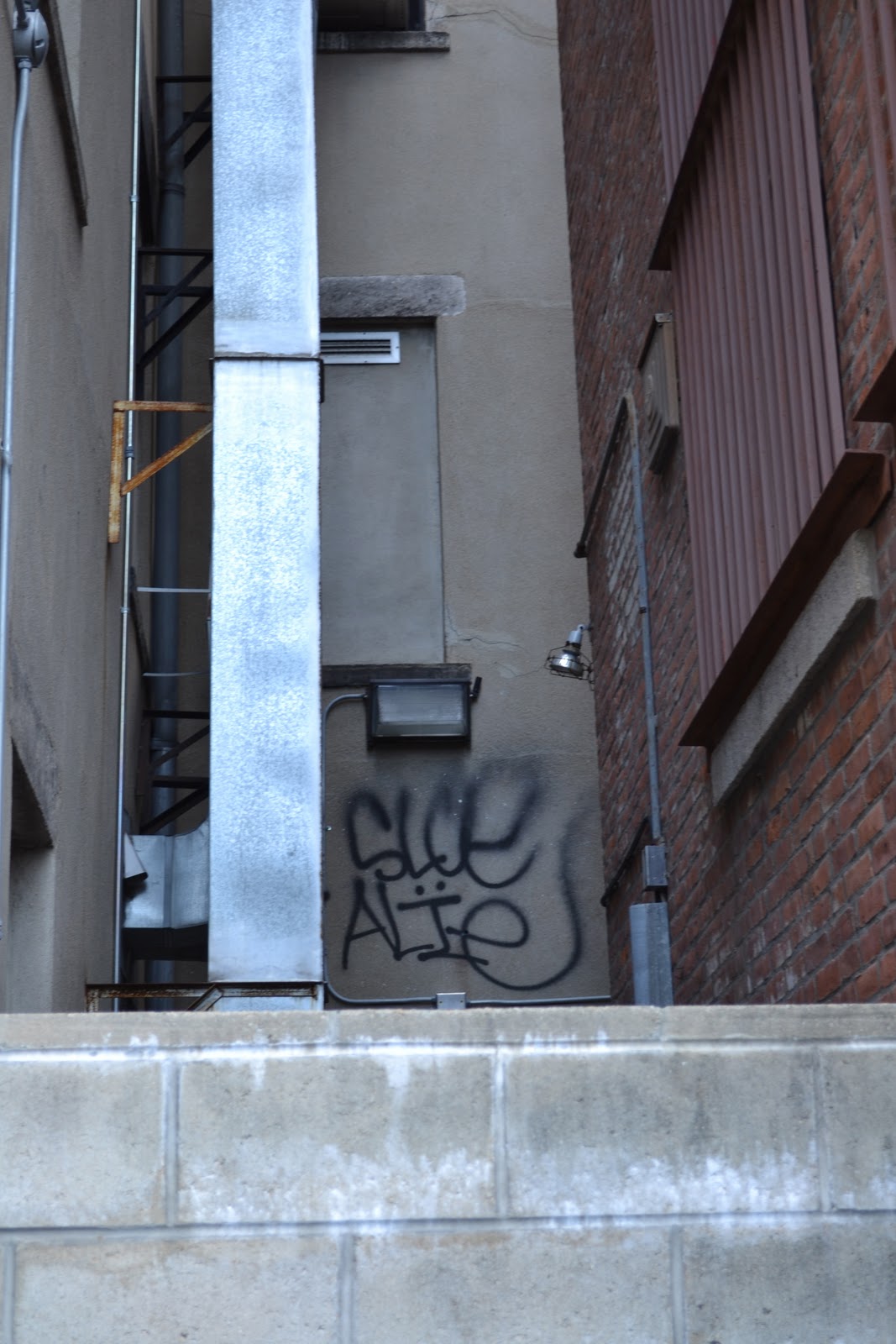
Graffiti on the side of the Arcade. The red brick building is (now) Providence Optical, and was built into the niche created by the Arcade's shape


View of the Weybosset facade of the Arcade

You might notice that the two porticos are different- the Westminster one has a pediment, while the Weybosset one does not. Purportedly, the two collaborating architects could not decide on a design, and so each designed one facade. 


View of the Arcade from Weybosset Street, facing north-east

The building that now houses Providence Optical was built to fit into the space left by the Arcade's shape. It is jigsawed in very satisfactorily. There is a photograph in the RIHS library of this view before that building was built, enabling me to easily conceive of the layering of the built environment over time.

Reflection of the columns in the glass display cases in the Weybosset portico


View along the interior of the Weybosset portico


View into the interior of the Arcade from the Weybosset portico


View of the second floor of the Weybosset portico


Dust and wear marks on the floor of the second level of the Weybosset portico


View of the Arcade from Weybosset Street across the empty lot on its east side. The remaining facade of the Providence National Bank, known as the "Weybosset Facade" can be seen on the left supported by iron scaffolding.


Memory triggers (memory)

My housemate, Evie, and I had an amazing experience this morning. I was listening to and editing the footage of my conversation with Marianne, when Evie said suddenly that she had been to the Arcade as a child. She had completely forgotten about it until she heard Marianne describing the craft shops on the second level, which triggered an entire set of memories:


A slice of time?

In an intentional set up, I ended my last post with the phrase:
in the temporal cross-section, or slice, of the year 1876.
The idea of a cross-section, or slice, of time is an attractive visual conception-- it fulfills our desire to see the unseen, conjuring up images that range from a scientific dissection revealing the knowledge of a body's insides to a delicious slice of pie, which again involves a view onto the gooey, sugary inside and gaining an understanding of how it is put together. But it can suggest that this slice exists independently of other times. In other words, in reinforces the idea of linear time, where past, present and future exist in a progressive and independent relationship to one another. This concept functions well enough for some purposes, but is not adequate in understanding the way that we experience the world. Our experience of the world, particularly in this case of place, is one where time is cyclical and interwoven; our memory function constantly challenges linear time by bringing pasts into presents, old buildings stand next to new (as Laurent Olivier reminds us, although the Arcade might have been built in the nineteenth century it is also a 21st century building by virtue of its existence in the present), and my experience of the building is defined by the interdependence of the present and the past as I delve into archives and seek out memories.

These theoretical reflections stem from when my first interviewee, Marianne, was recalling the types of shops that defined the Arcade and the surrounding area to her. This was very soon after I had been looking at and thinking about the advertisements from the Hand-Book. It was a strong reminder of exactly the way in which  I am caught up in a complex interplay between the pasts and presents of the building (futures too if you consider the hopes or thoughts on the possibilities for the Arcade's next phase of life or my plans for the development of this project).

Marianne's engagements with and memories of the building were primarily in the 1970s and 1980s when she was a student at RISD. It was a place she would go to treat herself to a coffee and a snack, and she recalls the first floor being dominated by places that served food ("they had the best cookies at the Arcade...that was what I used to go for...the gigantic chocolate chip...that was a treat.") with a different feel to the upper levels. In the period before the mall, downtown was the place to do your shopping, and Marianne recalled that "it was almost as if you had Thayer Street in one building" but more "like a well rounded marketplace". She also described the specific character of the Arcade shops:


One of the first things that came up in our conversation was the impression that the space made on her:


Marianne made a comment similar to the observation I made in a previous post about the Arcade being dwarfed by the buildings that have grown up around it. But despite her description of a "canyon", she feels that the Arcade retains it's grandeur upon entering- humans are still dwarfed by its scale, but not so much so that it is overwhelming.


This observation about the difference between Weybosset and Westminster streets is something I notice still. When I was there on the same day that I talked to Marianne, I had noted down that Westminster street always seems a little more populated than Weybosset. Marianne commented that this reflects the sight lines from the intersection at the Turk's Head; from here, there is a straight vista down Westminster Street, but the Arcade is invisible on the Weybosset side because of the way the road bends.

One of the most interesting things to hear from Marianne was that she remembered there being stories about the columns of the Arcade. Later in our conversation she specifically recalled reading aProJo (Providence Journal) article about the breaking of one column. Turns out that this article is by none other than Brown University's own Robert P. Emlen, University Curator and senior lecturer in the AmCiv department-- one of the people I have been intending to get in touch with about this project. Marianne's knowledge of this story and the article indicate that there continues to be interest in the stories surrounding the Arcade that have been associated with it in the secondary archival sources I have come across.

Wednesday, September 14, 2011

ABC- Ads, Bonnets, Commerce

In a previous post, I briefly quoted from J. C. Thompson's 1876 Illustrated Hand-Book Providence to illustrate some of the language employed to describe the Arcade. But actually, the most interesting insight that this little publication has to offer is found in the pages before and after the text of the main work. The opening and closing pages contain contemporary advertisements, densely packed up against one another, full of illustrations and eye-catching fonts, and three of them advertise shops located in the Arcade.

The first is found on the first page, and is a full-page ad for H. J. Gould & Co.'s "Dry Goods at Bottom Prices". They were located in "28, 30 and 32 Arcade (up stairs)" and sold all manner of cloths and garments including silks, satins, thibets, bombazine, brilliantines, velveteens, muslins flannels, laces, gloves, corsets, collars, and cuffs. They also specifically advertise that they carried "black goods"- i.e. many of the above came in black for mourning purposes.

On page vii is placed an ad for "Julius Carroll, dealer in Fashionable Millinery" at 27 and 29 Arcade. The motto for this shop was "First Class Goods at low prices".

The third that appears is on page xii: S. H. Adams, at 44 and 46 Arcade on the second floor in the store formerly occupied by E. Mason. The ad is for Cheap Millinery Rooms- spaces to rend for the sale of millinery goods. Also specifically advertised are "medium and elegantly trimmed Hats and Bonnets".

While three examples cannot be taken to be comprehensive, they do suggest that the Arcade at this point in time heavily represented the millinery trade, and there is an emphasis in all three on the ability to find cheap goods. Looking at the other advertisements that surround these ones in the pages of the Hand-Book also give an interesting insight into some of the other businesses that surrounded the Arcade downtown, and nearby on South Main Street. To share a couple of examples, the ad adjacent to S. H. Adams' cries, "Business Men, do your own Printing on the Dunkerly Self-Inking Printing Presses", which were sold at "No. 207 Dyer Street, corner of Dorrance". And at 20 and 24 Westminster Street, just east of the intersection with Weybosset Street, was located Baker, Whitaker & Co., importers and jobbers of Hardware and Cutlery.

Beyond providing exciting information about the specific businesses in the Arcade, the ads in Thompson's Hand-Book also allow us to construct a spatial-commercial conception of the Arcade and its immediate surroundings in the temporal cross-section, or slice, of the year 1876.