This project has been made possible by a grant from the Creative Arts Council of Brown University.

Monday, September 26, 2011

Encounters- 21/9/11

On Wednesday 21/9/11 at 2:15pm I was sitting on the Westminster steps of the Arcade after creating the video walk. I realised that for the video walk I took almost exactly the same route as I did when I was down here last time- am I becoming habitual so quickly? Re-enacting the same bodily path is reassuring- it contains less unknowns. But at the Arcade, where the unknowns were fairly minimal for me, it is a telling indicator of how quickly we bodies like to fit ourselves into routines, habits, rituals. It seems I have already created an embodied practice for my visit to the Arcade and, to use a phrase coined by Paul Connerton, was drawing on my "habit-memory" to re-enact that practice (see Connerton, "How Societies Remember"around page 22).
There were a good number of people on the steps, and going into the tobacco shop. As I walked back through the alley, there had been a woman leaning against the railing, reading a book and smoking a cigarette (she had not been there a few minutes earlier when I walked through). As I sat on the steps, she emerged from the alley, crossed the street and went into the Bank of America building directly across from the Arcade.

While I was sitting observing the traffic in and around the Arcade, my attention was drawn to one person in particular who went into and, a little while later, came out of the shop. I approached him to ask him about his experiences with the site:


I went into the tobacco shop to talk to the owner. He was very willing to share his knowledge of the site, but asked that I did not record it. Anthony has owned the shop for the last six years, and is able to continue to lease the space in part because he does not use any of the utilities- heat, electric, air conditioning- of the Arcade. He has his own systems, which the owners do not have to be responsible for. I asked Anthony if he knew how long the shop would stay open. He said he didn't know how long he'd be there, and when I asked if that was in terms of next year, he said sometimes he wasn't even sure day to day. When the Arcade closed, the other corner space on the Westminster side also continued to be leased by a shoe shine man. However he closed up soon after of his own accord. Since the Arcade closed, Anthony's store has has much less traffic, unsurprisingly. He said in general, the whole of downtown has a lot less traffic because of all the empty retail spaces.

As I was making notes about my conversation with Anthony, a group of RISD students (I found out later they were in an illustration class) led by a professor filled the portico of the Arcade. The professor began giving a mini lecture about the building, which I of course sidled over to listen to, trying to blend in (not sure that I succeeded). The students then turned around to hear about the Bank of America building opposite, and then continued down Westminster on their classroom-outside-the-classroom tour that, for a brief time, had caused their paths to cross both my path and the path of the Arcade.

Friday, September 23, 2011

Movement beginnings

Over the last few days, I have met for the first time with the dancers to introduce them to the project, and to start experimenting with process and generating some movement. They are six wonderful people that I am so excited and privileged to work with, and they each bring a valuable set of knowledge and insights to the project. Here are some thoughts on the Arcade from the performers that came out of our first few rehearsals:


Nadia: 
Before this project I had never heard of the arcade. Up until this point, my relationship with providence has been more or less college hill, leaving only to go the mall or out to eat. When Elise first described this project to me in the spring, and the possibility of using the arcade as the space, I imagined (and I can't really say why) an old, abandoned, grandiose building in ruin: a building that closed before my lifetime. After reading the blog and hearing Elise speak in our first meeting, I realized that the history of the arcade is very recent and alive. I listened to a few of the recordings on the blog and started to equate the stories and feelings around the arcade with places from my childhood. The arcade seemed to be a place for adventures or for tradition and comfort. I have not yet gone to see the arcade, but there are very poignant places in my past with these same ideas attached to them. For this reason, as of now, my connection with the arcade is purely emotional. 

Kelli:

First thoughts--I have a foggy recollection of going to the Arcade a couple of times when it was still open, when I first arrived in Providence in 2007. Thinking about it now, I realize that on some level I've begun to question the truth of this memory...maybe I merely imagined entering. The building has been closed for the majority of the time I have lived here, and so my sense of it as an inaccessible space has begun to cloud over any recollections of walking in and meandering along the central corridor. And yet, at the same time, I recognize now that I have regarded the arcade expectantly throughout the period of its closure, awaiting what seems to be an imminent reopening. My memories of the space, be they real or imagined, are of skylit yet dimmed grandeur and shops that felt subtly anachronistic even though they peddled modern foods and wares. Somehow even then I felt as though I was trespassing, as though I didn't quite belong in the structure in much the same way the structure itself didn't quite belong amidst its surroundings. 


Natasha: 
The arcade is, from the outside, a solid monumental structure. That is sits on a narrow cobblestone street rather than on a stately lawn situates it firmly in an older time. From the inside, it has at once the impact of an open aired courtyard (due to the mezzanine level and open double story topped by skylights) and of a hallway. In fact, being in the middle of a rather long city block with only alleyways on either side, the arcade served a a more appealing warm indoor street or shortcut between streets. I grew up here, and knew it as I grew up. As a home to shops my mother would take me to, as the site of choral concerts in winter, and as a place to spend my lunch break with friends when I worked downtown in my early twenties.


Amy:


I wanted to introduce the dancers to some of the research materials that I have been gathering, and see what would happen if they were asked to integrate movement with sound. The directive in this improv exercise (I did this with all the dancers in small groups, this clip shows Kelli and Amy) was to listen; both to the recorded conversations that I played as a soundscape to their movement, and, perhaps more importantly, to each other. Here, I was interested in them paying attention to the relationship between themselves and the other person. Spatially, but also emotionally and psychologically. 


Interestingly, although perhaps not surprisingly, the feedback that I got from all the dancers concerned the way that it was hard to listen equally to both simultaneously. For most of the dancers, the experience was that their focus was weighted towards one or the other at a given time, although it shifted between the two. For others, however, the soundscape was just that. A soundscape more than intelligible words, where the breath and rhythm of different voices was their overriding impression as they focused on being in movement dialogue with one another. 


The concept explored in this exercise is the kernel for future work, as eventually I want to be exploring the dancers' spatial and psychological relationships not only to each other, but to the site. This, ultimately, is what place is about- it is a meeting place of spatial/physical relations, emotions and memories, the material and the human, where the lines between these categories blur.

Thursday, September 22, 2011

Bodies, movements, place

I want to follow up my last comment in the previous post with another quote from Bloomer and Moore:
The interplay between the world of our bodies and the world of our dwelling places is always in flux. We make places that are an expression of our haptic experiences even as these experiences are generated by the places we have already created. Whether we are conscious or innocent of this process, our bodies and our movements are in constant dialogue with our buildings. (1977, 57)
In the large body of scholarship on place and space theory there is an interest in the way that the movements of bodies through spaces change and create places. It might be helpful here to think of Yi-Fu Tuan, who once distinguished place from space by saying that place has value invested in it, since space becomes valued the moment that our own bodies are present in it.  This "dialogue", to use Bloomer and Moore's term, between bodies and buildings is exactly what I am trying to get at. Although in my work, in addition to this dialogue occurring unconsciously as people walk down a street or climb up a flight stairs, it is a dialogue consciously sought after and delved into, and intentionally created to be shared with others through performance.

Taking a step back from the performance with which this project will culminate, my actions as I undertake my research also fall into the category of place making. My body is engaged in a conscious dialogue with the Arcade as I observe, listen to, walk around and talk (to and with others) about the site. My place making today took the form of creating a video walk. I wanted to record the footage to have as part of my research materials, or personal archive of the site, but I also was aware of the implications of my place making actions. For most of the other people around me, my actions stood out as different, unusual, and I attracted more attention than I would have done if I were just walking. I singled out the area in which I was walking and recording as having more significance in that moment than it might have otherwise had for the people around me, and in doing so shifted their perceptions of that place, however briefly. In that moment, places were re-made.


In the video you will notice that there are a numer of empty drinks cans around the two porticos- some sitting upright and some tucked into the railings. These were not present the last time I went down to the Arcade. It is most definitely a lived place. 


Tuesday, September 20, 2011

Balconies

I also talked to Adj last week, a friend who grew up in the East Providence area, and for whom the Arcade was first connected with the rebellious act of coming into downtown Providence as a teen.


One of the most striking moments of our conversation was when Adj described her second visit to the Arcade during one of Providence's Art Walks, almost a decade after her last memory, when the balcony was the aspect of the building that left the strongest impressions:


Photograph showing the second floor balcony from the Weybosset Street side. Photo by author, 12/9/11

For me, Adj's experience of the interior of the Arcade on her first visit brings to mind the relationship between interiors and the interiority of self addressed by some architectural theorists. In Body, memory and architecture, Kent C. Bloomer and Charles Willard Moore talk about the idea of "body spatiality." In contrast to a mathematical, objective understanding of space, body spatiality "refers to an internal world which is not only distinct from and within an external world, but which is centered around "landmarks" and bodily memories that reflect a lifetime of events encountered outside the psychic body boundary" (1977, 45). In his musings on architecture in A Place of My Own, Michael Pollan notes that a similar idea comes up in the work of Philippe Ariès concerning the simultaneous emergence of the private study and the modern sense of the individual during the Renaissance. Pollan writes, "Apparently this is no accident: The new space and the new self actually helped give shape to one another. It appears there is a kind of reciprocity between interiors and interiority" (2008, 8). 

The difference between these two examples is in the presence of the body. The sense of self that Pollan and Ariès address refers to the psyche of the individual, and whilst the body is present as the medium for interacting with the space of the private study, it is a medium separate from the mind- a duality inherited from Descartes. Bloomer and Moore emphasise the need to overcome this separation, and their choice of the phrase "psychic body boundary" points to this. Their work is relevant to what I am exploring, because moving beyond the separation between mind and body is crucial to my approach to place-based dance. Conceiving of the boundary between mental and kinetic/physical processes as fluid and shifting is essential to exploring the potential of the cross-roads of meanings of places and embodied movements within them. 

More stories

Last week I had the pleasure of talking to several other people about their experiences involving the Arcade. In one session I talked to Laura and Rosanna, who grew up in Providence together, and who shared their insights into the site through the lens of young pre-teens in the early 1980s.

Laura and Rosanna had some great memories involving rainbow headbands, christmas choirs, and cookies, among other things:


They also talked about how the Arcade was decorated and hung with garlands at Christmas time, and students from Classical High School, including Rosanna, performed with the choir in the Arcade:


It has been striking the frequency with which the tiles of the Arcade floor have come up. Marianne, Evie, and Rosanna all mentioned the tiles, with no prompting.


Another theme that has been emerging is the comparison between the Arcade and Providence Place Mall. The malls were responsible for pulling shoppers away from downtown, and away from the Arcade, but as Laura and Rosanna mentioned PPM has a very different feel from the fluorescent-lit, boxy malls of the 1970s. The skylight and multiple levels of PPM definitely give it an arcade-like feel, and it is interesting to maybe consider PPM as a reincarnation of the Arcade.

Monday, September 19, 2011

Orientations

In my (over?) familiarity with Providence, I never included any kind of map to orient the Arcade, both in terms of cardinal directions and in terms of the city. So a little belated, but here is what Google Maps has to offer:

This "map" view shows downtown Providence. I have circled where the Arcade is located.


 This "satellite" view again shows downtown Providence, with the Arcade circled.


This aerial is a close up of the Arcade. It shows the way in which the building stretches across the entire lot between Westminster and Weybosset. It also shows how Providence Optical (shown in photos in the previous post) and other adjacent buildings were neatly fitted into the spaces left by the floor plan design of the Arcade. 

Friday, September 16, 2011

12/9/11- photos

This post is a little belated, but shares some of the photos that I took at the site on 12th September 2011. I was there on a weekday around 1pm, and so got to experience part lunch time in the business district.

View of the Arcade from Westminster Street looking south-west


View of the Westminster facade of the Arcade, looking south-west


Women chatting and eating lunch on the steps of the Arcade, Westminster facade. 

Notice the sign displayed prominently on the street advertising the presence of the little newsagents shop located in the north-east corner of the Arcade. I went in to talk to the owner. He said that although he had only been running the shop for six years, it has been there for twenty-five, and the space is leased from the owners of the Arcade. There seemed to be fairly regular traffic in the little shop, where there is barely room for two customers to stand shoulder to shoulder, with people coming in to pick up things like cigarettes, gum, or something to snack on. 

Oddly placed marble steps and an empty cigarette packet in the Westminster street portico


Notice taped to the door of the Arcade (Westminster entrance)


View up to the second level of the Westminster portico


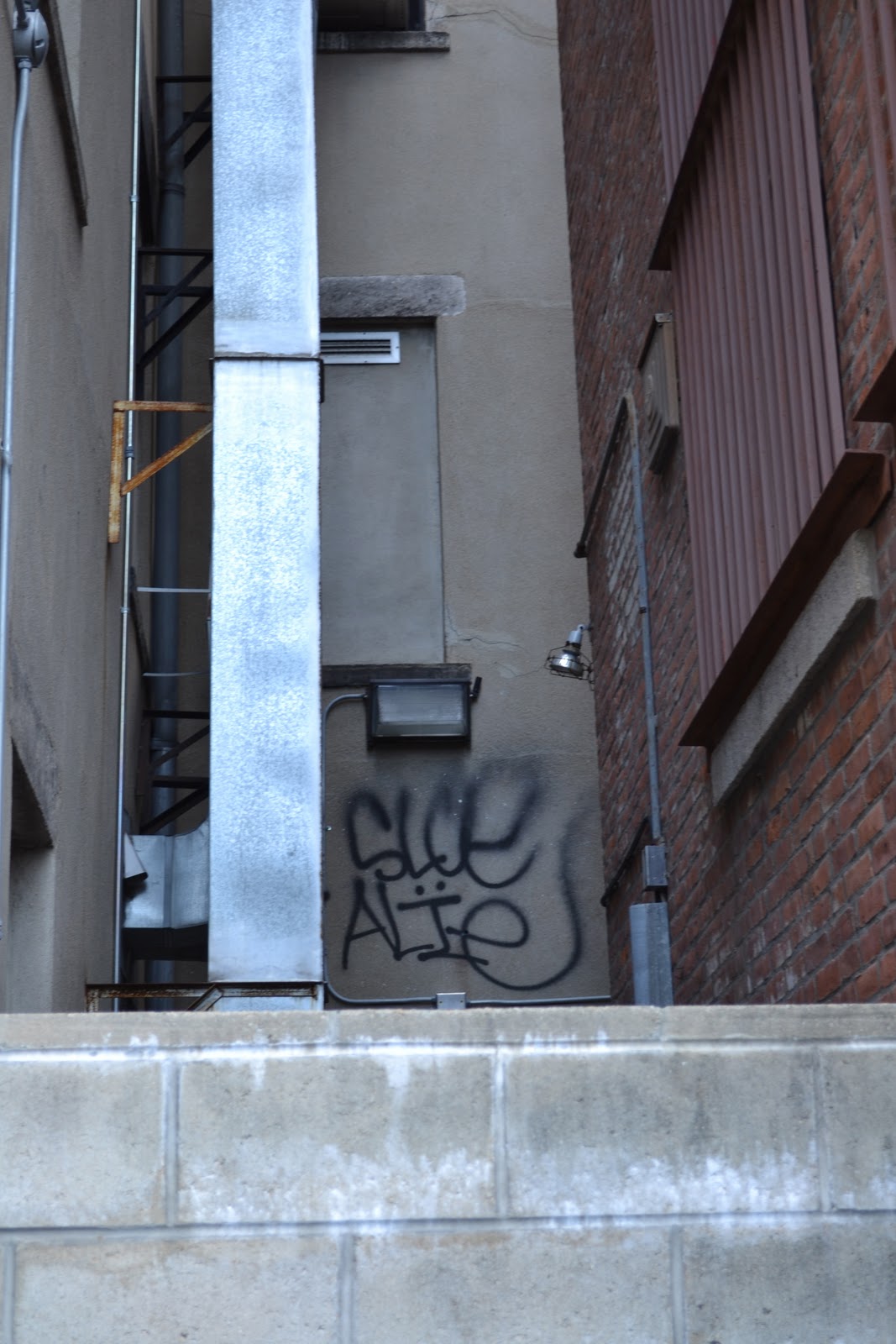
Graffiti and a sticker on the south wall of the Westminster portico


View back towards Westminster Street from the alley on the west side of the Arcade

This alleyway was something that I had not noticed before. I probably wouldn't have noticed it then, except that while I was sitting on the edge of the Westminster portico, two men walked out of the alley right next to me. It leads down the side of the Arcade, and comes out on the Weybosset side next to the eatery "Tommy's Place" and into a parking lot. 

Graffiti on the side entrance to the Arcade in the alley


Chippings and rust at the foot of the Arcade in the alley


Graffiti on the side of the Arcade. The red brick building is (now) Providence Optical, and was built into the niche created by the Arcade's shape


View of the Weybosset facade of the Arcade

You might notice that the two porticos are different- the Westminster one has a pediment, while the Weybosset one does not. Purportedly, the two collaborating architects could not decide on a design, and so each designed one facade. 


View of the Arcade from Weybosset Street, facing north-east

The building that now houses Providence Optical was built to fit into the space left by the Arcade's shape. It is jigsawed in very satisfactorily. There is a photograph in the RIHS library of this view before that building was built, enabling me to easily conceive of the layering of the built environment over time.

Reflection of the columns in the glass display cases in the Weybosset portico


View along the interior of the Weybosset portico


View into the interior of the Arcade from the Weybosset portico


View of the second floor of the Weybosset portico


Dust and wear marks on the floor of the second level of the Weybosset portico


View of the Arcade from Weybosset Street across the empty lot on its east side. The remaining facade of the Providence National Bank, known as the "Weybosset Facade" can be seen on the left supported by iron scaffolding.